Sealing Challenge in Automotive Interiors
The EPDM sponge rubber plays a pivotal role in the automotive industry, meeting the demand for cost-effective, high-quality, and durable automotive components. As Tier 2 suppliers, you are well aware of the pressure to deliver quality products. The EPDM sponge rubber, a critical component in the automotive interior, significantly impacts the NVH and HVAC performance. It facilitates the efficient transport of cold air from the vehicle HVAC system to the automotive interior, a key function in vehicle comfort.
The EPDM rubber sponge appears simple, but it is crucial for the comfort of the passengers. Low quality or improper materials and poor automotive rubber insulation can result in major problems in the NVH and HVAC systems, early ageing, and failure of the rubber. This, in turn, reduces customer satisfaction and increases the warranty claims.
This blog is a comprehensive guide for Tier 2 suppliers, addressing the challenges of sourcing and evaluating the EPDM sponge rubber. It also delves into how Saga Elastomers, a trusted partner, supports Tier 2 suppliers with early-stage prototyping, component evaluation, and ITAF compliance. With Saga Elastomers by your side, you can navigate the complexities of EPDM sponge rubber sourcing with confidence.
EPDM Sponge Rubber: The Best Choice for HVAC Pipe Insulation
The EPDM sponge rubber is critical in the automotive industry owing to its heat resistance, flexibility, and sealing properties. While aiding the cold air pipe insulation in the cabin, EPDM sponge provides –
- Thermal Insulation – Maintains the cold air temperature during transit.
- UV & Ozone Protection – Resilience in high UV and ozone-exposed areas
- Flexibility & Low Compression Set – Preserve the rubber shape and flexibility under heat
Thus, the EPDM sponge substantiates itself as the natural and best fit for HVAC rubber parts that are exposed to repeated thermal cycling vibration.
Common Sourcing Pain Points in Tier 2 Automotive
EPDM sponge rubber has diversified usages and advantages in vehicle applications, especially for the seals, gaskets, and NVH. The Tier 2 automotive suppliers often face challenges in sourcing that impact the quality and manufacturing efficiency. These challenges include inconsistent material density, compression set failures, incompatibility with tooling, lack of validation data, and limited support for OEM compliance. These pain points result in remarkable disruption in the supply chain, compromising the product performance with stringent OEM compliance.
- Inconsistent Density
One of the issues that is often reported is the inconsistent material density. The EPDM rubber must meet the specific density requirements to support the HVAC and sealing performance. But, due to a lack of process and control at the sub-supplier and rubber compounder, the density of the rubber varies frequently between various batches. This results in arbitrary results in the finished parts. Some components may also underperform, resulting in water ingress and more. - Compression Set Failures
Compression set refers to the material’s flexibility and its ability to return to its original shape after being compressed. The EPDM sponge rubber rebounds effectively and maintains a compact sealing over time. But, subpar components and an insufficient curing process result in high compression, deforming the rubber after use. This leads to compromising the seal integrity, loosening the rubber over time, causing water and air ingress. - Incompatibility with Tooling
Tier 2 automotive suppliers commonly outsource component production, inviting another challenge: tooling incompatibility. If the EPDM compound is not manufactured and tested following the production tooling, discrepancies in the dimensions and defects on the surface finish are definite to occur. This misalignment triggers high rejections, expensive rework, and modifications. - Lack of Validation Data
The QA Engineers need early access to the component validation data, such as the prequalified samples or the compound datasheet, to figure out the suitability of the materials. However, some EPDM rubber suppliers do not provide the data, which complicates the rubber compound validation early in the process. Thus, it increases the risk of failures in the last minute and production delays. - Limited Support for OEM Compliance
Lastly, numerous rubber suppliers are not fully prepared to support the accurate documentation and the quality standards needed by the OEMs and the ITAF 16949 compliance. With a lack of traceability, material validation data, and certifications, PPAP, the Tier 2 suppliers face the immense challenge of maintaining compliance. This adversely impacts their supply chain and business.
Role of Cold Air Pipe Insulation in NVH
Modern vehicles have HVAC systems that include ducts to transport the cool air through the narrow pipes to the various zones in the cabin. These ducts, when they pass through the vehicle dashboard and side panels, may turn out to be an unplanned source of NVH failure if –
- The insulation rubber breaks under compression and thermal exposure.
- Vibrations are transferred from the compressor/blower through the hard rubber.
- The rubber material cracks and becomes brittle due to extreme ozone exposure.
The EPDM sponge rubber, with its high resistance, long-lasting, and lightweight properties, insulates thermally.
Key Specifications to Validate
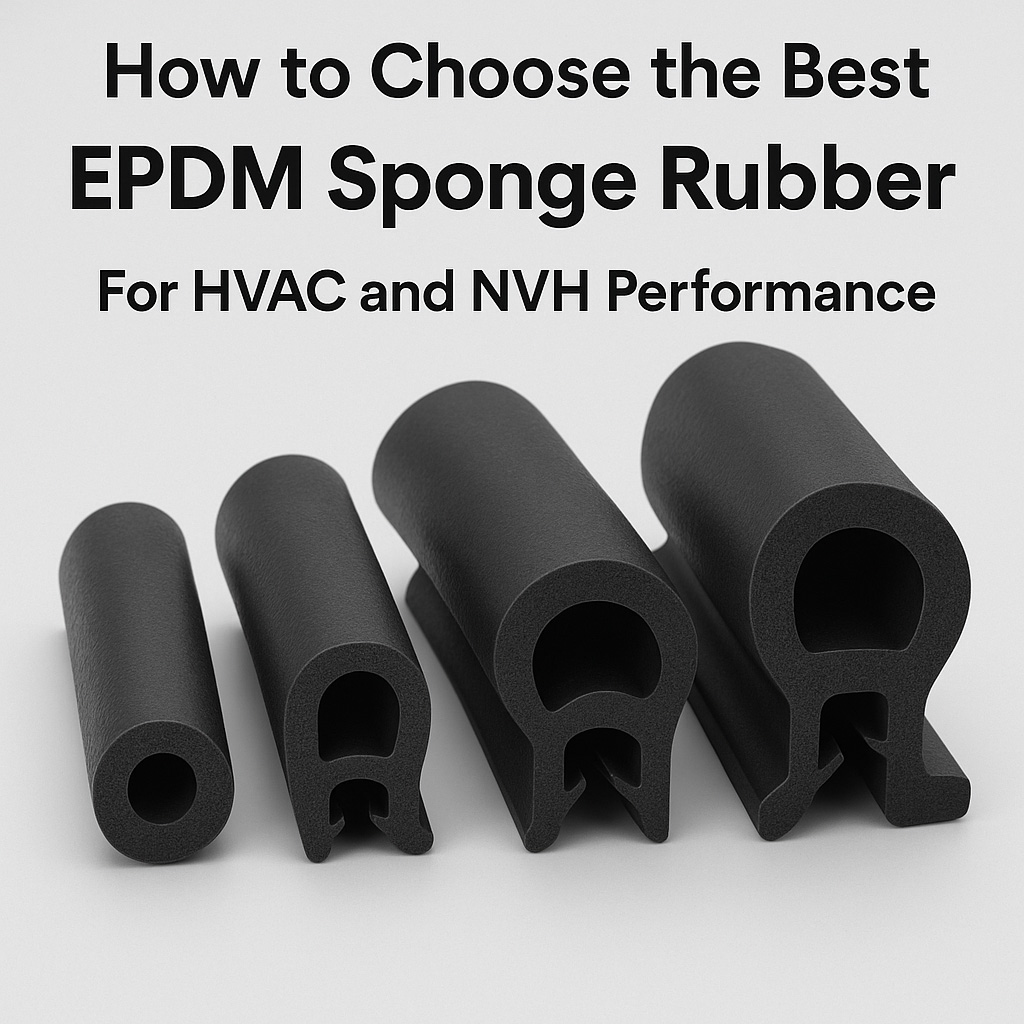
While selecting the EPDM sponge rubber for the HVAC insulation pipes, evaluate the following key specs before zeroing in –
| Specification | Requirement Range | Why It Matters |
| Density | 0.25 – 0.7 g/cm³ | Lowers density to improve insulation and consistency |
| Compression Set | <25% | Ensures long-lasting sealing and shape retention |
| Shore Hardness | 25-45 Shore OO | Softer grades reduce vibration transmission |
| UV/Ozone Resistance | Must meet ASTM D1171 | Enhances durability in exposed areas |
| Thermal Range | -40°C to 120°C | Withstands operational fluctuations |
FAQs for the Tier 2 Suppliers
Q: Can I use a general quality EPDM sponge for HVAC ducts?
Ans: It is not recommended to use the general quality. Automotive-grade EPDM sponge is specially manufactured for long-term exposure to compression and ozone resistance.
Q: How to validate EPDM sponge rubber from a new supplier?
Ans: To validate, it is important to request samples, to test under your application load, and check the QC reports for compression set and density.
Q: What support can I get if my tooling is already built?
Ans: Saga offers component compatibility testing to make sure that your existing tools can be adapted for our rubber.
Why High-Quality EPDM Sponge Rubber Matters More Than Ever
As the global OEM tightens the quality parameters, particularly focusing on the HVAC and NVH systems, Tier 2 suppliers must be highly vigilant. The quality of EPDM sponge rubber is more crucial than ever, with poor rubber parts leading to rejected batches, production delays, and potential loss of business. By partnering with Saga Elastomer, you can ensure that your EPDM sponge rubber meets global standards, thereby securing a seamless supply chain and your business reputation.
How does Saga Elastomer Support?
Saga Elastomer supports the Tier 2 automotive suppliers by minimizing the risk associated with sourcing and boosting validation of the products by –
1. Prototyping in the Early Stage
Saga Elastomer engages with the R&D and the Q&A teams of the suppliers to provide custom samples in the primary design phase to enable engineers to prequalify the test materials before the tooling process. This helps to figure out the –
- Accurate rubber profile dimensions
- Levels of compound hardness
- Simulated operating conditions (temperature, pressure)
2. In-House Compound Validation
In-house lab facility of Saga Elastomer provides full compound evaluation as follows:
- Rubber compression set performance tests for flexibility and shape retention
- Density tolerance checks for better insulation
- UV/Ozone simulation for durability
- Dimensional stability under vibration to prevent misalignment
We release each batch with proper QC certifications along with data sheets supporting the Tier 2 suppliers to build OEM trust.
3. IATF 16949 Compliance
Our manufacturing and documentation processes are fully IATF 16949 compliant. This includes:
- Control methods
- PPAP documentation
- Traceability mechanisms
Partner with Saga Elastomer for Proven EPDM Sponge Rubber
If you are looking to source EPDM rubber for strict HVAC insulation and NVH performance with stringent quality standards to meet, Saga Elastomer is here to support you as a partner. Contact us today to remove your sourcing headaches and confidently deliver to your OEM customers.