If you design the groove, specify the seal, or troubleshoot leakage—this is for you.
Shore A hardness is a useful control parameter for rubber hardness selection, but by itself it is not a sealing strategy.
Seals don’t fail because “55 Shore A was wrong.” They fail because the joint did not generate and maintain the required contact pressure across tolerances, temperature, time, movement, and assembly realities.
Hardness is one input. Sealing is a system outcome: design × compound × cure × installation × environment.
1) Rubber Hardness Selection Basics: What Actually Drives Sealing Performance
Hardness influences
- Contact pressure at a given squeeze (harder → higher contact pressure for the same compression, up to a point)
- Conformability (softer → fills micro-gaps better; tolerates rough/uneven surfaces)
- Assembly force & friction tendency (hardness affects it, but geometry and surface often dominate)
- Stability in the groove (harder carriers resist creep and pull-out better)
Hardness does not reliably predict
- Compression set (a 70A compound can have poor CS; a 55A can be excellent)
- Long-term sealing retention (stress relaxation + joint design dominate)
- Leak tightness by itself (geometry + squeeze + tolerance variation matter more)
2) The 4 variables that should drive hardness selection
A) Squeeze % (the first “real” spec)
Squeeze = how much the seal is compressed in the joint.
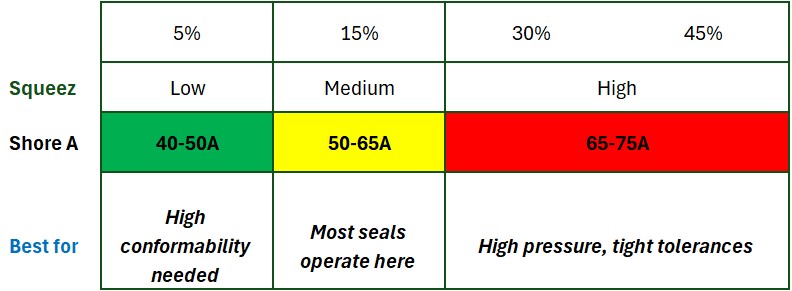
- Low squeeze (5–15%) → needs high conformability or geometry that concentrates contact pressure
- Medium squeeze (15–30%) → most seals live here
- High squeeze (30–45%+) → risk of high assembly force + long-term set if not designed carefully
Key point: For a given geometry, hardness is your dial to reach target contact pressure within your squeeze window.
B) Contact pressure requirement (what you’re really buying)
A seal leaks when contact pressure is lower than the forces that open micro-leak paths:
- internal fluid/air pressure
- joint roughness, parting lines, tolerance gaps
- deformation under service load
This is why 70A can leak: if squeeze is limited or the geometry doesn’t load correctly, you get inadequate contact pressure where it matters.
C) Friction & assembly force (the hidden failure mode)
A seal that seals in theory but cannot be assembled consistently becomes a production failure:
- seals are stretched, twisted, installed dry, or damaged
- seating is incomplete (and leakage appears “unexplained”)
Hardness influences force, but surface tack, lubrication strategy, and groove geometry often dominate.
D) Tolerance stack-up & movement (static vs dynamic)
- High gap variation → softer seals maintain contact better
- Dynamic sliding → too soft can increase wear and frictional heat
- Pressure + extrusion gap risk → may require higher hardness and/or anti-extrusion support
3) Why 70A can leak and 55A can seal better (and vice versa)
Case 1: 70A leaks, 55A seals better
Typical when:
- squeeze is limited
- tolerance variation is high
- surfaces are rough/uneven
- geometry spreads load rather than concentrating it
Result: 70A may not conform enough to close micro-gaps at low squeeze; 55A can.
Case 2: 55A leaks, 70A seals better
Typical when:
- higher internal pressure or pressure peaks exist
- extrusion gaps are present
- seal must resist deformation to maintain contact pressure
Result: 55A deforms or relaxes too much; 70A holds shape and pressure.
Takeaway: Hardness is not “better or worse.” It is “matched or mismatched.”
4) The 40 Shore A zone: when soft seals are the right answer (and when they fail)
A) 40A solid O-cords / rings (static sealing, high conformity)
Works well when
- low-to-moderate pressure static sealing
- imperfect alignment, surface irregularities, slight ovality
- low assembly force + high conformity are required
Can fail when
- an extrusion gap exists (clearance + pressure)
- long-term compressive load drives stress relaxation and loss of contact pressure
- high stretch during fitment demands excellent elastic recovery
Practical guidance
- Use 40A when extrusion is controlled by design
- Validate sealing after dwell (24–72 hours), not only on day one
B) 40A hollow EPDM seals with splice joints (easy-fit / roll-fit)
Common pitfalls
- high friction/tack → difficult sliding/rolling → installation damage
- splice weakness due to localized strain
- compression drift when squeeze varies or stress relaxation is high
What to control
- friction/tack behavior (functional surface requirement)
- stress relaxation at service temperature
- splice design + cure matching
5) When one hardness can’t do two jobs: co-extruded seals (hard carrier + soft bulb)
Typical architecture
- Hard carrier (~65–75A, dense): retention, groove stability, pull-out resistance
- Soft bulb (~35–45, often sponge/foam): tolerance take-up, sealing at low force
Important note: For sponge, density + compression behavior often matter more than Shore A.
Define: density range + load-deflection at specified squeeze + recovery after cycling.
Validate: interface peel/tear strength, especially at corners/radii and after cycling.
| Application type | Typical pressure | Movement | Key risk | Starting hardness |
| Weather/dust/water exclusion | Low | Static | tolerance variation | 50–65A |
| Static gasket sealing (controlled squeeze) | Moderate | Static | relaxation + aging | 60–75A |
| Clamp sleeves / interference on metal | Low–Moderate | Mostly static | assembly damage vs creep | 55–70A |
| Dynamic wiping / sliding | Low–Moderate | Dynamic | wear + friction heat | 65–80A |
| Soft/high-conformity seals (O-cord, hollow bulbs, easy-fit) | Low–Moderate | Static | extrusion gap + relaxation + friction | 35–50A (only if extrusion is controlled) |
| Lock-fit + soft sealing requirement | Low–Moderate | Static/Dynamic | retention + tolerance | Co-ex: carrier 65–75A dense + bulb 35–45 sponge |
Rule of thumb: If extrusion gaps or pressure peaks exist, increase hardness and/or add anti-extrusion support—do not rely on softness alone.
7) Validation approach (how we de-risk field failures)
- Prototype two options (e.g., 60A and 70A; or 40A vs 50A)
- Validate using a joint-level fixture that matches squeeze/tolerances, surface finish, cycling, and installation method
- Track: seating consistency, assembly force, leak/ingress performance, recovery after cycling, and set/relaxation after dwell
This turns hardness selection from opinion into engineering.
If you’re defining a seal or troubleshooting leakage, share any two of the following and we can recommend a starting hardness strategy and minimum validation plan:
- joint sketch/photo or groove dimensions
- squeeze window / installed height range
- service temperature range + peaks
- media exposure (water/air/oil/cleaner/adhesive/paint)
- static vs dynamic movement
Our approach is simple: spec hardness as a control metric, but qualify sealing at the joint level—because that’s where failures (and reliability) are actually decided.